sexta-feira, 2 de novembro de 2012

2. Explain the need for a ventilation system

http://isite.lps.org/sputnam/LHS_IB/IBBiology/Unit8Human%20Physiology/Respiratory/RespNotes.htm

Our body is composed by millions of cells, but only the outside cells are directly exposed to air, and the other millions are too far from the outside air to make use of diffusion to supply oxygen. Therefore, the ventilation system, together with the circulatory system, works in order to gather oxygen molecules in the inner portion of the lungs and transport that oxygen to all the body cells.

Also, ventilation system is needed to maintain the concentration gradients of gases in the alveoli. to ensure the diffusion of each gas in the direction that it is supposed to follow - the body needs to get rid of carbon dioxide and needs to take oxygen in. 

3. Describe the features of alveoli that adapt them to gas exchange

http://www.funscrape.com/Search/1/alveoli.html 

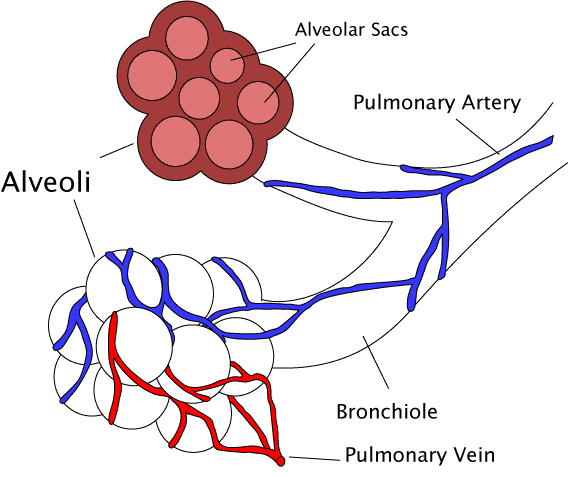
1. Each alveolus is very small. However, the lungs contain hundreds of millions of alveoli, which gives a huge surface area for gas exchange. 

2. As the capillary wall, the wall of the alveolus is made of a single layer of extremely thin cells, creating a short diffusion distance for the gases. 


3. Alveoli are covered by a dense network of blood capillaries with low oxygen concentration and high carbon dioxide concentration. This allows diffusion of oxygen  into the blood and carbon dioxide to diffuse out of the blood. 


4. In the alveolus wall, cells secrete a fluid that keeps the inner surface of the alveolus moist, which allows gases to dissolve. the fluid also contains a natural "detergent" that prevents the sides of one alveolus from sticking to another alveolus.   

4. Draw and label a diagram of the ventilation system, including trachea, lungs, bronchi, bronchioles and alveoli

http://www.ibguides.com/biology/notes/gas-exchange-
When you inhale air through mouth/nasal passage:

1. Trachea

2. Bronchus 

3. Bronchioles

4. Alveoli.

5. Explain the mechanism of ventilation of the lungs in terms of volume and pressure changes caused by the internal and external intercostal muscles, the diaphragm and abdominal muscles


When we inhale (breath in), the external intercostal muscles contracts and moves the rib cage up and out. As abdominal muscles relax, the diaphragm contracts - moves down - and becomes flat, allowing more air inside. The muscle activities increase the volume of the thorax and its pressure drops. At last, air flows from the outside into the body/lungs until the pressure inside the lungs rises back.

For exhaling (breath out), the opposite happens: the internal intercostal muscles contracts and moves the rib cage down and in. Abdominal muscles contract and the diaphragm moves up. The muscle activities decrease the volume of the thorax and the pressure rises. Than, air flows out from the lungs to the environment until the pressure inside the lungs falls.