sábado, 3 de novembro de 2012

4. Outline the control of the heartbeat in terms of myogenic muscle contraction, the role of the pacemaker, nerves, the medulla of the brain and epinephrine (adrenaline)


- Myogenic muscle contraction means the heart muscle can contract by itself. 
- In the wall of the right atrium, the pacemaker (SA nodes) is located, region that initiates each heart contraction, and whenever the pacemaker sends a signal, the heart contracts and causes a heartbeat. 
- Nerves and hormones are responsible for transmitting messages to the pacemaker; the adrenaline, for example carries the massages from the medulla of the brain to the pacemaker telling it to speed up the beating.
- Another nerve sends a massage telling the pacemaker to slow down the beatings.


5. Explain the relationship between the structure and function of arteries, capillaries and veins

http://click4biology.info/c4b/6/hum6.2.htm


Arteries have a thick outer layer of longitudinal collagen and elastic fibers to avoid leaks. It also contains a thick wall to deal with the high pressures, as well as a narrow lumen to maintain these high pressures and thick layers of muscle fibers to help pump the blood after a hearth beat. Its function is to carry blood away from the heart to the body, under high pressure.

Veins are responsible for returning the blood to the heart, under low pressure. It is composed of a thin outer layer of longitudinal collagen and elastic fibers, since there is no risk or leaking and bursting. It also has a thin walls that allows the vein to be pressed by muscles, helping to move the blood. It contains thin layers of muscle fibers, since the blood does not flow in pulses, and the lumen is wide because of the slow-flowing blood.

The capillaries' walls are made of a single layer of thin cells so the distance for diffusion is small. It has a very narrow lumen so that the capillary can fit into small spaces and contains pores between the cells to allow some of the plasma to leak out and from tissue fluid.

6. State that blood is composed of plasma, erythrocytes, leucocytes (phagocytes and lymphocytes) and platelets


Blood is composed of plasma, erythrocytes, leucocytes - phagocytes and lymphocytes - and platelets. 

7. State that the following are transported by the blood: nutrients, oxygen, carbon dioxide, hormones, antibodies, urea and heat


Nutrients, oxygen, carbon dioxide, hormones, antibodies, urea and heat are all transported by the blood.

sexta-feira, 2 de novembro de 2012

6.4 Gas Exchange


IB Assessment Statements
1. Distinguish between ventilation, gas exchange and cell respiration 

2. Explain the need for a ventilation system 

3. Describe the features of alveoli that adapt them to gas exchange 

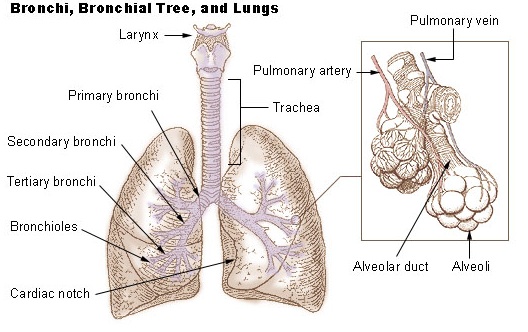
4. Draw and label a diagram of the ventilation system, including trachea, lungs, bronchi, bronchioles and alveoli 

5. Explain the mechanism of ventilation of the lungs in terms of volume and pressure changes caused by the internal and external intercostal muscles, the diaphragm and abdominal muscles 

1. Distinguish between ventilation, gas exchange and cell respiration


Ventilation: Is the process of inhaling and exhaling. (The air in the alveoli needs to be refreshed frequently). 


Gas exchange: Is the process of exchanging one gas for the other. (Carbon dioxide - oxygen).


Cell Respiration: Is the chemical process that occurs in the mitochondria and energy is released as ATP. 

2. Explain the need for a ventilation system

http://isite.lps.org/sputnam/LHS_IB/IBBiology/Unit8Human%20Physiology/Respiratory/RespNotes.htm

Our body is composed by millions of cells, but only the outside cells are directly exposed to air, and the other millions are too far from the outside air to make use of diffusion to supply oxygen. Therefore, the ventilation system, together with the circulatory system, works in order to gather oxygen molecules in the inner portion of the lungs and transport that oxygen to all the body cells.

Also, ventilation system is needed to maintain the concentration gradients of gases in the alveoli. to ensure the diffusion of each gas in the direction that it is supposed to follow - the body needs to get rid of carbon dioxide and needs to take oxygen in.